Evaluation of Durability of Metal Materials in Offshore Structure Applications
Keywords:
Material Durability, Offshore Structure, Corrosion, Stainless Steel, Structural IntegrityAbstract
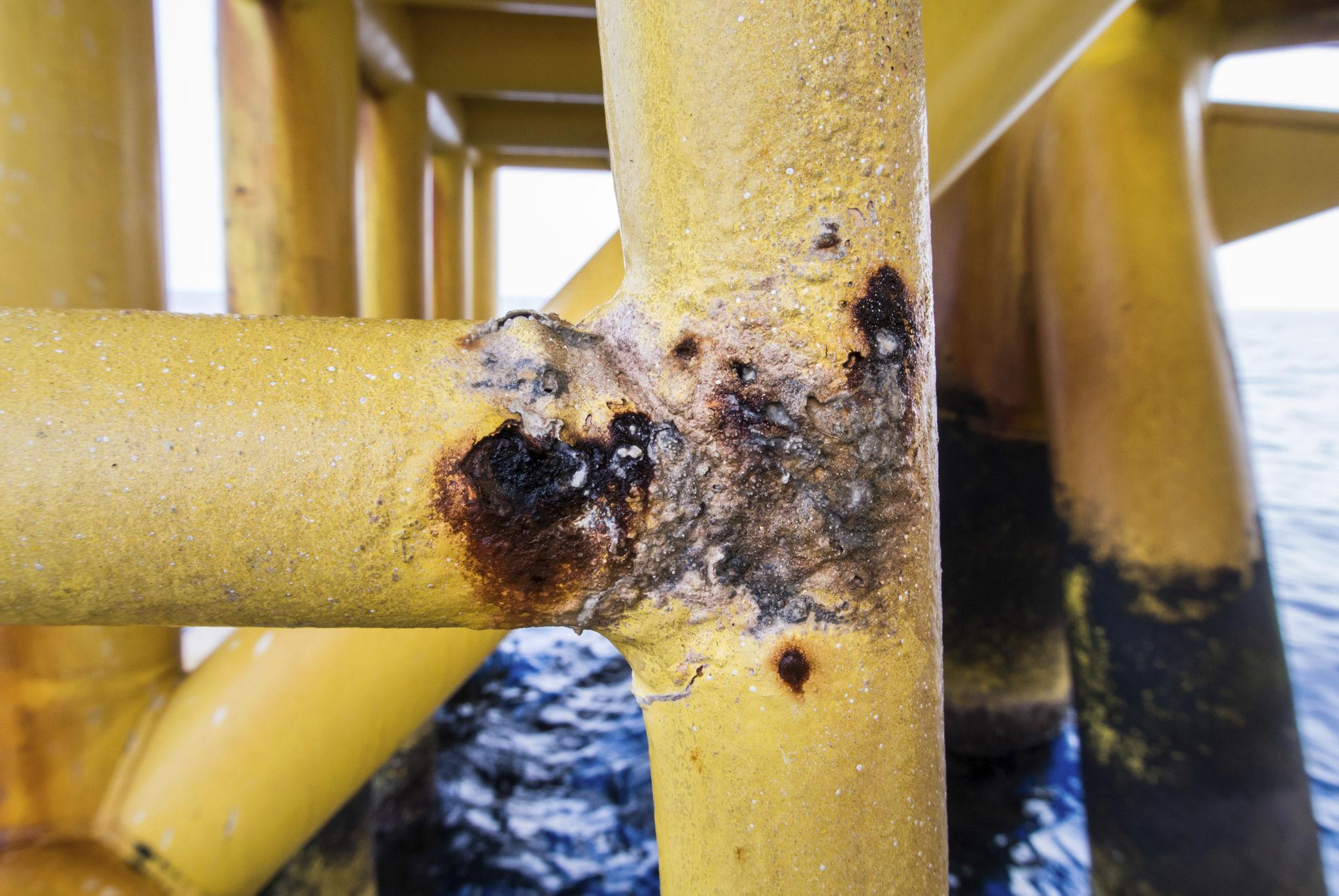
Offshore structures such as oil and gas drilling platforms, underwater pipelines, and maritime operations support platforms operate in extreme environmental conditions, including exposure to seawater with high chloride content, temperature fluctuations, hydrostatic pressure, and biological activity of marine microorganisms. These conditions make the metal materials used in these structures susceptible to degradation in the form of corrosion, material fatigue, and degradation of mechanical properties over operational time. This problem is crucial considering that structural failures in offshore installations not only have an impact on economic losses, but also have the potential to pose occupational safety risks and pollution of the marine environment. This study aims to evaluate the durability of metal materials, especially carbon steel and stainless steel alloys, which are commonly used in offshore structures, by analyzing the influence of the seawater environment on corrosion rates, fatigue resistance, and changes in the mechanical properties of materials. The methods used include electrochemical testing to measure the rate of corrosion, tensile and hardness tests to evaluate the mechanical properties before and after exposure to the simulated seawater environment, as well as surface morphology analysis using a microscope to identify patterns of damage that occur. The results of the evaluation are expected to provide an overview of the level of resistance of materials to offshore operational conditions and provide recommendations related to the selection of appropriate materials and protection strategies, such as the application of cathodic protection or anti-corrosion coatings, to extend the service life of the structure and improve operational reliability in the marine environment. This research is expected to be a reference in the design and maintenance of offshore structures that are more durable and safe.
References
[1] N. E. A. Nassar, "Corrosion in marine and offshore steel structures: Classification and overview," Int. J. Adv. Eng. Sci. Appl., 2022, doi: 10.47346/ijaesa.v3i1.80.
[2] A. Shittu, A. Mehmanparast, M. Shafiee, A. Kolios, P. Hart, and K. Pilario, "Structural reliability assessment of offshore wind turbine support structures subjected to pitting corrosion‐fatigue: A damage tolerance modelling approach," Wind Energy, 2020, doi: 10.1002/we.2542.
[3] A. Anna and V. Romanovski, "Corrosion and Degradation of Materials in Marine Environments: Implications for Coastal and Offshore Infrastructure," Eng. Reports, vol. 8, 2026, doi: 10.1002/eng2.70922.
[4] B. Weihnacht et al., "Sensor platform for periodic integrity inspection of subsea structures with a permanently installed measuring system," e-Journal Nondestruct. Test., 2024, doi: 10.58286/29692.
[5] M. Abbas and M. Shafiee, "An overview of maintenance management strategies for corroded steel structures in extreme marine environments," Mar. Struct., vol. 71, p. 102718, 2020, doi: 10.1016/j.marstruc.2020.102718.
[6] J. Xu, H. Lu, L.-L. Cai, Y. Liao, and J. Lian, "Surface Protection Technology for Metallic Materials in Marine Environments," Materials (Basel)., vol. 16, 2023, doi: 10.3390/ma16206822.
[7] L.-K. Xu, Y. Xin, Li, H.-B. Zhang, Z.-F. Lin, and X. Li, "Challenges and Solutions of Cathodic Protection for Marine Ships," Corros. Common., 2021, doi: 10.1016/j.corcom.2021.08.003.
[8] P. Krishnamoorthy, C. Tremblay, and P. Jackson, "Offshore Underwater Fixed Structure Integrity Assessment Using LRUT, PEC & ACFM Advanced Technologies with Minimal Marine Growth Removal," Day 3 Wed, Oct. 04, 2023, 2023, doi: 10.2118/217037-ms.