Capturing Ocean Energy
Wave Energy Innovation for the Future
Keywords:
Wave Energy, Renewable Energy, Marine Technology, Electrical Energy, MarineAbstract
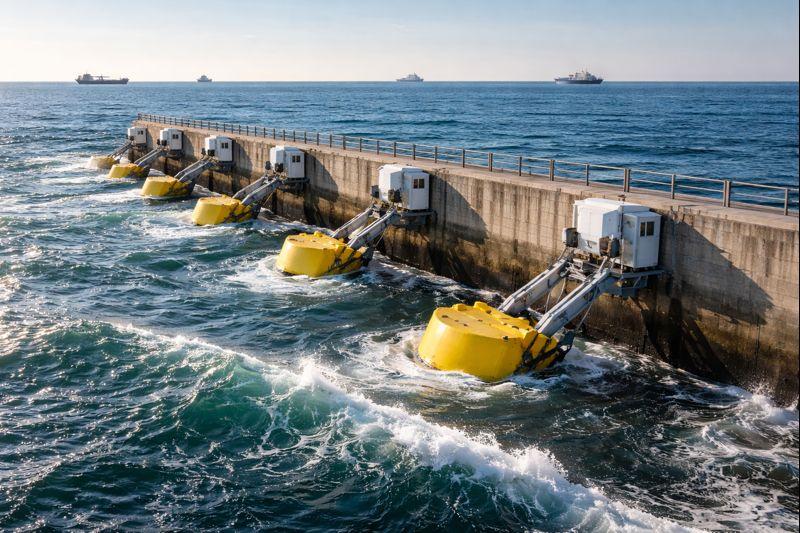
Sea waves are one of the energy sources that have the potential to be used as renewable energy. Indonesia as an archipelagic country has a large sea area and quite a lot of sea waves in various regions. Energy from waves can be converted into electrical energy using technology wave energy. This technology is interesting because it utilizes naturally available energy sources and can help reduce the use of fossil fuels. However, its application still has some obstacles, such as fairly high development costs, changing wave conditions, equipment maintenance, and marine environmental conditions. Therefore, the development of wave energy technology needs to be carried out gradually taking into account marine conditions and community needs. With good management, wave energy can be one of the energy sources of choice for the future [1].
References
[1] K. P. Wijaya and R. Maulana, “Ocean Wave Utilization for Renewable Power Generation Using Wave Energy Converters (WECs): A Review,” J. Clean Technol., 2025, doi: 10.15294/joct.v2i2.29271.
[2] S. Wolf et al., “Scientists’ warning on fossil fuels,” Oxford Open Clim. Chang., 2025, doi: 10.1093/oxfclm/kgaf011.
[3] N. Nandalianadhira, M. Hermanto, and R. A. Saputra, “Assessment of Small-Scale Offshore Wave Energy Potential Near Enggano Island for Local Sustainability and Energy Independence,” in IOP Conference Series: Earth and Environmental Science, 2026. doi:10.1088/1755-1315/1585/1/012023.
[4] W. Xu, J. Chen, S. Gu, X. Feng, and F. Wang, “A Pull‐Out Mooring Wave Energy Converter: Design, Analysis, and Application,” Adv. Sci., vol. 13, 2025, doi: 10.1002/advs.202516945.
[5] R. Kumar, “Tribological challenges in ocean energy systems: Failure mechanisms, materials, lubrication strategies, and reliability roadmaps,” Results in Surfaces and Interfaces, 2026, doi: 10.1016/j.rsurfi.2026.100750.
[6] H. Li et al., “Advanced wave energy conversion technologies for sustainable and smart sea: A comprehensive review,” Renew. Energy, 2024, doi: 10.1016/j.renene.2024.121980.
[7] E. Edwards et al., “The effect of device geometry on the performance of a wave energy converter,” Common. Eng., vol. 4, 2025, doi: 10.1038/s44172-025-00441-2.
[8] M. Baghaei, T. Rabczuk, C. Anitescu, M. Bamdad, and H. Goharnejad, “Wave energy assessment in the Pacific Northwest under historical and future climate conditions: a case study of the Canadian and U.S. coasts,” J. Ocean Eng. Mar. Energy, vol. 12, pp. 1557–1582, 2026, doi: 10.1007/s40722-026-00502-4.
[9] R. Satymov, D. Bogdanov, M. Dadashi, G. Lavidas, and C. Breyer, “Techno-economic assessment of global and regional wave energy resource potentials and profiles in hourly resolution,” Appl. Energy, 2024, doi: 10.1016/j.apenergy.2024.123119.
[10] S. Beselly, M. Sajali, K. Murakami, and M. Syabana, “Assessment of wave energy resources and optimal WEC site selection on the south coast of Malang East Java,” in IOP Conference Series: Earth and Environmental Science, 2026. doi:10.1088/1755-1315/1593/1/012044.